Tuesday, September 26, 2006

Kids grill scientist dad (with ketchup and mustard)

stain2

stain3

Bethany and Alex Maynard: The Woodward and Bernstein of the nanotech age? Watch (.mov 20.1MB) how they grill their dad, Andrew Maynard, chief scientist with the Project on Emerging Nanotechnologies at the Woodrow Wilson International Center for Scholars.

Molecular self-assembly creates biped

Remember my two experiments in human bottom-up self-assembly? (See here, here, here, here, here and here.)

The first one is 2 years old now, but is so tall he is often mistaken for a 4-year-old. And the youngest one is 1, also a giant. But this specimen has recently evolved into a biped. Excellent. Excellent. Once he is old enough to develop his own musical tastes, I hope he retains his love for Johnny Cash. Click above to see the subject "Walk the Line."

Monday, September 25, 2006

Religious voices would enhance nanoethics debate

Congratulations to Patrick Lin and his Nanoethics Group, which was just awarded a three-year, $250,000 National Science Foundation grant to study the ethics of human enhancement and nanotechnology.

Patrick, in a news release, says:

"The ethics of human enhancement technologies is widely held to be the single most important debate in science and society and will define the 21st century. Today, human enhancement may mean steroids or Viagra or cosmetic surgeries. But with the accelerating pace of technology, some of the more fantastic scenarios may arrive sooner than people think – such as advanced cybernetic body parts and computers imbedded in our brains – which magnify the ethical issues involved."

I've been saying for years that this issue is going to become more and more politically divisive -- ever since a warning against enhancement popped up in the nanotech bill in Congress back in December 2003. I hope the Nanoethics Group's study goes a long way toward getting some data involved in the debate rather than pure emotion.

I also hope the group allows more than token religious voices in the study. While some opposition to enhancement comes from the far left (don't mess with Mother Nature), a great deal of the political opposition will come from the religious point of view -- and I do not mean only the religious right.

This is no criticism of Patrick's group, but I have noticed a shortage of the voice of religion within ethical debates over nanotechnology. This is due to many factors, but primarily the traditional antagonism between scientists and the religious.

The result, I believe, is often scientists being "out of their depth" when it comes to discussions about the implications of their own work. At worst, this exclusion means that the concerns of millions of people in the world are laughingly dismissed out of hand. Many scientists have simplistic, or grade-school-level, ideas of religion and the role it plays in the public at large and base their debates on science and ethics on these simplistic assumptions.

To exclude the role of religion in ethical debates over nanotechnology would be the equivalent of a group of religious leaders who have a passing interest in physics getting together to determine the merits of string theory vs. loop quantum gravity, and think it ridiculous to let physicists participate in the debate.

Backgrounder
Rational science for an irrational world
Converging ideologies against human performance
You say you want an evolution ...
Better, faster, stronger?
Congress is thinking about thinking
Evangelicals and Nano-Gnosticism
Nano superhero is, appropriately, a golem

Friday, September 22, 2006

Huh? Who?

A redesigned Small Times Web site introduces a larger ad well, links to white papers and, apparently, says goodbye to old rubbish.

Backgrounder
Flirtin' with freelance disaster

Wednesday, September 20, 2006

Dr. Nano's Travelin' Medicine Show

haney   haney   haney

Checking the readout on my nanoscamometer, this latest slice of NanoBaloney scores three Mr. Haneys (out of, oh, let's say six), since this snake oil is probably less harmful than steroids and I give the writer credit for the ability to use a broad range of impressive sounding words (and even one acronym) to say absolutely nothing.

SportMedix, Inc., a subsidiary of ProtoMedix, Inc., has announced their first group of nanotechnological-based sports supplements specifically designed for professional and amateur athletes is ready for market. These sports supplements, called C.L.E.A.N. (Compete Legally Excel Athletically with Nanotechnology), have been endorsed by ASAP (Anti Steroid Athletics Program) as a safe way for athletes to improve their health and mental abilities. ...

SportMedix Inc. is a developer of nano-structured bioregulators, controlling the biological processes responsible for normal functionality of all organs and tissues, as well as optimizing and correcting the operation of all three major body systems: endocrine, nervous and immune. More here

Backgrounder
Nanotech's real danger is the nano con
'Super thick non-digestible' nano
Son of McMonkey McBean
'Nano' for your aura
'Crain's-ing' my neck to see the hype
Dirty diesel done 'nano' cheap?

Monday, September 18, 2006

My other life as a nanotech pitchman

This feature on Arrowhead Research Corp. in Fast Company magazine, written by my friend and former Small Times correspondent Michael Fitzgerald, was based on an idea I pitched to Michael back when I did some public relations work for Arrowhead.

I do not want to insult Michael or Fast Company by making it appear that they are overly influenced by nanotech pitchmen, and Michael is experienced enough to know fluff from substance, but this is one example of how I can help nanotech companies get some media attention.

I have discovered that many firms are discouraged with professional PR agencies that not only have little clue as to what appeals to journalists, but also struggle with explaining their technology to the masses. I have no such problems.

Anyway, I've pitched a few companies (nano and non) recently on my ability to get results as a PR person. More examples are available by request. Here's a snippet of Michael's Fast Company story:

Nano Is Nice
Bruce Stewart is building a nanotech research conglomerate.

Bruce Stewart doesn't look like a nanotechnology magnate. At 69, he's old enough to dodder. He doesn't always finish his sentences. He doesn't have a PhD, and his background is in investing, not science. His business strategy? Be nice.

"My dad told me, 'Always have a smile and be friendly, and it'll pay back tenfold,'" Stewart says. He plans to make money with a daring approach to funding technology: He's trying to corner key nanotechnology research, then develop it commercially. His company, Arrowhead Research Corp., has assembled more than 160 key patents in nanotech. It has started four promising companies, and it's sponsoring research at Duke, Stanford, and the California Institute of Technology.

Arrowhead is far enough along, in fact, that two of its shareholders upped their stakes by almost $20 million in January, although the company likely won't deliver significant revenues for at least two more years. "If nanotech is going to be a big business, Stewart will have built the model," predicts Doug Thomas, president of JET Investment Research in Lancaster, Pennsylvania. More here

Friday, September 15, 2006

Zombie nanobot warfare

This video really needs no introduction or explanation. Just enjoy.

Finding the Molecular Foundry

foundry

"If Ikea made nanotech laboratories, this is what they would look like," reports the Chemistry World blog in a teaser to the publication's planned feature on the new Molecular Foundry in Berkeley later this year.

"Bare wood and beige carpets" contradict the "foundry" image that brought anti-nanotech protesters out to the construction site during the past couple of years. No, this is not some nanotech update to a Diego Rivera mural of an industrial plant, where exploited workers and unsuspecting townspeople are breathing in nanofumes belched from nanosmokestacks.

This is a new kind of multidisciplinary foundry of the mind, where scientists from many disciplines now find their work converging on the nanoscale. I can't wait to find out what comes out on the other side of the assembly line.

Backgrounder
A Sad Jab at the 'Bad Rad Lab'
Nano not hep to this cat
Lost and Foundry

NanoCon Quiz

haneyNanoCon? This refers to:

A. A dwarf criminal

B. A small-town snake-oil salesman

C. A tiny, ideologically driven foreign policy adviser to the Bush administration

D. An unfortunate name for a nanotechnology convention

Backgrounder
Nanotech's real danger is the nano con

Thursday, September 14, 2006

A bunch of nano characters

Those who are interested in nanotech and toxicity, or want to know what measures the U.S. government is taking to ensure the safety of nanomaterials being proposed for pharmaceuticals, might want to subscribe to this new publication by the Nanotechnology Characterization Laboratory (NCL).

The NCL was created as a resource for all private-sector nanotech cancer researchers to help them transition their concepts to clinical applications and to facilitate contact with the U.S. Food and Drug Administration (FDA).

I spoke a little while ago with NCL Director Scott McNeil. I caught him just as he was taking a break during a conference on nanotoxicity. McNeil said he found it "remarkable" that, outside the media spotlight, groups like Environmental Defense and government agencies were able to meet and do more than just argue.

The NCL was created only a year ago, and one of the first issues it is working on, McNeil said, is the need for similar characterization methods and standards. Let's make sure that scientists at Stanford and MIT, for example, can compare results by speaking the same language.

I couldn't tell you what the different measurement standards are, but I can imagine it might be about as confusing as when I drive through Canada to get from Detroit to upstate New York. Paying Canadian dollars to buy "imperial gallons" of gas leaves me wondering exactly how much the darn transaction really cost me.

Another area where there is a "critical lack of understanding," McNeil said, is in structure/activity relationships. For example, what makes a drug-delivering molecule like a dendrimer more or less toxic? Is it size alone? What about when scientists monkey around with the surface charge? What happens in various size/surface charge combinations with different types of nanomaterials?

To put it even more simply: When you read in your local newspaper about how scientists are unsure about all these "strange new properties" that exist at the nanoscale and that's what scares the bejeezus out of everybody, remember that it's not only about the size of your particle, baby. It's how you charge it. And don't believe the claim that the U.S. government is not doing anything to figure this stuff out.

The NCL. Don't launch a nanotech initiative without one.

Backgrounder
Nano ISO standards
Hey, Nano, what are your measurements?

Wednesday, September 13, 2006

Nanodiagnostics, where are you?

It has been a hazy 48 hours. My 1-year-old had a fever-induced seizure and I spent a wonderful night with him in the ER and pediatric ward. They're common, yet incredibly frightening if it happens to your kid. He's fine now. The only damage is to daddy's sleep cycle (don't even want to think about the bill right now). The experience did remind me what nano is all about when it comes to diagnostics, though. Can't we get those damn test results in sooner?

Monday, September 11, 2006

Happy 9/11!

Without realizing it, I've made Sept. 11 an almost-annual tribute to my daughter. 2003, 2004 (2005, I was on a blogabbatical). So, happy birthday, Sonya. It's a sure sign of aging, I know, but I can remember the day of your birth 15 years ago with a great deal more clarity than I can recall any single day of last week.

Friday, September 01, 2006

NanoBot Held Hostage: Week Two

But enough about me, let's talk about me. As we established in Week One: NanoBot Held Hostage (until Howard gets a job), I am a well-respected man among those who have worked with me, followed my work or have used my tummy as a trampoline. But, you may ask, "Is that all there is to you, Howard? There are a great many other competent editors out there looking for work. To say you're a dime a dozen would be an insult to the dime. What else can you do?"

And, to that I would answer, "Mom, please try to say positive things about me in public, but you do have a very good point."

What my resume might not reflect (and, come to think of it, I should probably add this to the document) is my research work these past two years since leaving Small Times. In addition to providing countless backgrounders for members of the media looking for information about nanotechnology in general or about the companies I've done contract work for, I also:

  • Researched and co-wrote a lengthy report on nanotech-enabled memory and storage for the market research firm NanoMarkets. Also for NanoMarkets: I edited and rewrote a research paper on batteries and fuel cells;
  • Researched and co-wrote a report commissioned by the U.S. Army tank command here in the Detroit area, evaluating MEMS and nanotech companies for possible partnerships in unarmed land vehicles;
  • Researched companies and labs working on ophthalmic drug delivery technologies for a major pharmaceutical firm.
  • Evaluated an author's proposal for Artech House, publisher of books for high-tech professionals. Then, about a year later, critiqued and fact-checked the author's final manuscript.
  • There's more, but I do take the phrase "nondisclosure agreement" very seriously and will certainly not blog them. And, as you might know, a large part of the job for a magazine assigning editor -- especially one covering a technology that had never before been covered as a business -- is conducting research during the assigning, rewriting and editing process. So, during the five years that I've devoted to covering this little nano corner of the world, I've done a great deal of behind-the-scenes work that you will not necessarily see in my clips, but that has resulted in better final products.

    Despite my loudmouthed, opinionated, egotistical, nutty-for-nanobots blog persona, I am also quite comfortable quietly sifting through background material on the nanotech of "here and now" and using my insights and experience to help spot trends. Those of you who read a great deal of literature about nanotech as a science, business and investment have probably read my work and not even known it.
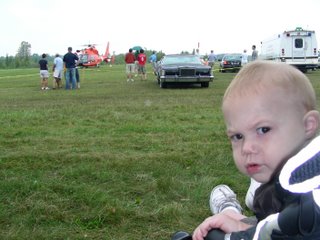
    chopperOh, and my son Sam tells me that I should have "researched" the weather a little better before making him sit in the stroller in the rain during the recent "Fly-In" at Woolsey Memorial Airport in Northport, Mich. As you can see, to use a cliche in community journalism, the rain did indeed "dampen the enthusiasm" of at least one spectator watching a helicopter take off.

    Friday, August 25, 2006

    NanoBot held hostage until Howard gets a job

    Nanotechnology news hounds, please stand by. This is one of the few times in NanoBot's three-year history that I've had to hijack this blog in the name of the first two words of the title: Howard Lovy. That's me. And I will continue to hold this indispensable nanofont of nanoinformation hostage until I have a full-time job with benefits (four weeks of vacation and use of a company jet would be nice, too, but I'll start ... um ... small).

    So, I'll start off this infomercial for me with some testimonials that colleagues have posted on the business networking site LinkedIn. At no time were any of these people bribed, blackmailed, medicated or otherwise coerced.

  • "Howard does unique and insightful research and has helped me keep fresh on topics in ways I wouldn't have thought." -- Scott Livingston, Managing Director - The Livingston Group, Axiom Capital Management
  • "Howard is an excellent editor. He consistently made my stories better by asking the right questions, and suggesting smart changes to my pieces. I would recommend him as an editor for any publication." -- Mark Frauenfelder, editor-in-chief of MAKE, O'Reilly Media
  • "I am a regular reader of Howard's blog, which is one of the more well read and respected blogs in the nanotechnology space. His forthright commentary on various matters related to nanotech is always refreshing to read in an increasingly hype-filled and paranoid world. His knowledge of the field is top notch." -- Deepak Singh, Director, NanoBiology Initiative, Accelrys
  • "Howard did an excellent job directing news coverage of nanotechnology at Small Times. He was clear on what made a good story for Small Times, insisted on smart analysis that went beyond the news, as well as clear definitions of the science involved. Howard also made sure his writers saw proofs of stories, a rarity in the online news world." -- Michael Fitzgerald, writer, editor
  • HandS"Dadda is a nice, big fat man whose tummy is fun to bounce on." -- Sam Lovy
  • Thursday, August 24, 2006

    Clip of Kurzweil on The Daily Show

    Here you go, NanoBot fans. Ray Kurzweil meets The Daily Show's Samantha Bee. Pardon the quality, but it's all the bandwidth I have. Enjoy.

    Kurzweil on The Daily Show

    dailyshow   kurzweildailyshow

    I interrupt my latest "I'm never blogging again until I can pay the bills" temper tantrum to bring you some breaking news. Samantha Bee, correspondent for The Daily Show with Jon Stewart on Comedy Central, just did a report on futurist Ray Kurzweil. Yes, nanobots were given the full Daily Show treatment, along with that guy who chipped himself. Pictures above were taken from my cameraphone in my living room. Further bulletins as they become available.

    Friday, August 18, 2006

    NanoBot Song

    I have a theme song now. Fame and fortune are sure to follow.

    Ladies, Germs and Mad Scientists, I give you my friend Homeless Dave of Ann Arbor, Mich., and NanoBot Song.

    Thursday, August 17, 2006

    Life could be a Dream Cruise

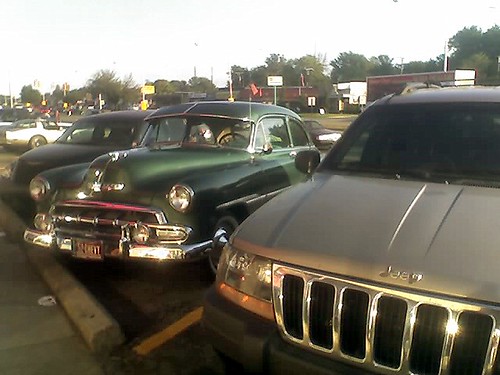
    Cameraphoning Detroit's Dream Cruise from my Jeep while schlepping the kids to Cottage Inn Pizza on Woodward Avenue. See the photos. Collect the set.

    Wednesday, August 09, 2006

    Hype or real? Yahoo has few answers

    Another Yahoo! Answers topic: "Is nanotechnology all hype or the real deal?"

    Answers range from the equivalent of "You're already soaking in it" to "it doesn't exist yet." The thing is, they are all correct, depending on how you want to define nanotech. (I lean toward the latter, but not all the way).

    I guess the main problem I have with Yahoo! Answers is not that some of the "answers" are questionable, but that the questions do not stay open long enough for the self-correcting peer review process to go into effect. For that, I'll stick with Wikipedia.

    Backgrounder
    Who answers at Yahoo!?
    Nanotech an open question at Yahoo! Answers

    Welcome to the Cyberpunk future

    The Cyberpunk nerds grew up, got jobs and converted fiction into reality.

    Backgrounder
    SciFi and the scientist

    Friday, August 04, 2006

    Pinhead Angels: The Video

    Remember THRONG (The Heavenly Righteous Opposed to Nanotech Greed)? I'm not sure, but I think they won the Nobel Peace Prize a year or so ago for their incredibly clever protest against nanotechnology. Employing a different tactic than their anti-nano cousins, THONG, a group of fully-clothed "angels" performed their street theater at a nanotech conference in Buckinghamshire, U.K.

    This video harkens back to December 2004, angelic chants of "no no nano nano no, no no no nano no no," sage words like, "We believe that nanotechnology is going to be a major can of worms. It's going to release all sorts of harms onto society and onto the environmnent" and the group's presentation of its "can of worms" award to Harry Swan, an ex-Monsanto official and now a nano-evangelist.

    Backgrounder
    Nanotech protest
    Pinhead Angels

    Tuesday, August 01, 2006

    Beware the well-meaning Westerner

    This spin on UNESCO's Ethics and Politics of Nanotechnology report concludes that developing nations are unlikely to lag behind the industrial world in nanotech research (this is correct, since poorer nations will likely focus nano research on their specific needs). But then it explores some dangerous, deadly territory:

    The report's editor, John Daly, says there is an urgent need for scientists to explore the potential hazards of nanotechnology, because materials at the nanoscale behave differently to how they do in bulk.

    "Where the effects of the nanomaterials are dangerous, regulation may be appropriate. But we don't have a very good understanding of where those dangers lie," he told SciDev.Net. More here

    Proceed with caution here. Remember DDT? The industrialized world, having already eradicated malaria in its own backyard, decided to impose DDT bans on the developing world. The result has been death in Biblical proportions. Beware the well-meaning Westerner who believes he knows what is best for the rest.

    If you don't believe me, listen to buckyball co-discoverer Sir Harry Kroto, who wrote in 2003:

    "Malaria has returned with a vengeance, and it is heart-rending that because of the DDT embargo - imposed with the future (mainly of westerners) in mind - a million African children die each year."

    Update: Andrew Leonard, my old editor at Salon (well, for the one article I did for Salon) has an excellent commentary on the blurry line between present-day nanotech reality and imagined dystopias.

    Backgrounder
    Without DDT, malaria bites back
    The Malaria Clock
    Death by Environmentalist

    'Nano Air Vehicle' is one-third mislabeled

    I wonder if those who are demanding "nano" labeling standards would want to crack down on the Defense Advanced Research Projects Agency (DARPA), whose Nano Air Vehicle program involves no actual nanotechnology.

    Just like a German company did in the "Magic Nano" con, DARPA is using "nano" as simply a synonym for "small." Any actual nanotechnology provided by Lockheed Martin would be pure coincidence.

    Update: My friend Jack Uldrich has the scoop at The Motley Fool.

    Backgrounder
    Magic Nano' nano? Naahhh
    Groups call for moratorium on nano-named products
    How low can nano go?