Friday, July 30, 2004

NanoSecond


Nano sunblock safety under scrutiny (ABC Science Online)

    We don't know enough about the safety of some nanoparticles, such as those already included in some cosmetics and sunscreens, a U.K. report has found.

    The report, just released by the Royal Society and the Royal Academy of Engineering, calls for further studies on the safety of nanoparticles such as the ultrafine zinc oxide powders currently used in some Australian sunscreens. The model Megan Gale launched one such product in Australia late last year. While the product was not specifically mentioned in the report, it contains zinc oxide particles 30 nanometers across. More NanoBot Backgrounder
    Nerd American Idol
    Don't hate me because I'm nano-beautiful
    Beauty and the Nano Beat

    Resources
    What's New in Cosmetics R&D
    L'Oreal's nanosomes
    Skin Science

UK: Nanotechnology: Whistle blown! (fiber2fasion)
    This relatively new technology announced recently as ‘the technology of the future’ has whistle-blower scientist calling for its ban.

    Reason according to them is that they pose health and environmental risks great enough to justify their ban form daily use. In a report commissioned by the British Government stated that their use in certain cosmetics now found on the U.S. market was a cause for concern. More

    NanoBot Backgrounder
    QuoteBot: Clayton Teague
    Britain balances science, economics, perception
    The Princess or the Dragon

Tiny materials make big splash on Wall St. (MSNBC)
    It's no surprise that science of the tiniest materials is making a big splash on Wall Street. It's a field that holds the promise of changing this century the way computer chips and biotechnology changed the last one. But investors still licking fresh wounds from the last "Next Big Thing" are justified in wondering if this latest innovation will turn out to be just another big way to lose money. More

    Related News
    Nanosys: The Giant Dwarf (Forbes)

    NanoBot Backgrounder
    IPO and Public Perception
    Initial Perilous Offering
    QuoteBot: Jeff Bezos

Oregon aims to get in on next small thing (Corvallis Gazette-Times)

Thursday, July 29, 2004

QuoteBot


"I think we have an appropriate level of research and development underway to look into potential risks associated with nanoscale materials."
Clayton Teague, director of the National Nanotechnology Coordination Office, quoted in the Washington Post

NanoBot Backgrounder
Interview with Nano's 'public face'
A little story about drugs, bass and balls
Bucky rage and 'imaginative commentators'

ETC Group Reacts


UK Report: More Hits than Misses on Nanotech

    After a year-long investigation, the United Kingdom’s Royal Society and Royal Academy of Engineering released its final report today examining the health, safety, environmental, ethical and societal implications of nano-scale technologies. The report was commissioned by the UK government last June. The UK’s Trade Union Congress today supported the Royal Society’s report and called for strong regulations to prevent worker exposure to manufactured nanoparticles. "There have been plenty of red flags, but the dollar signs have blotted out the warnings signs," said Rory O’Neill, spokesman for the Trade Union Congress.

    "The report is a good start toward addressing the potential negative health and environmental impacts of nano-scale technologies, particularly the use of nanoparticles," said Jim Thomas, European Programme Manager of the ETC Group based in Oxford. "Just one year ago Lord Sainsbury [UK Science Minister] said that nanotech was adequately covered by regulations — he was wrong. We welcome the Royal Society’s precautionary language on the environment and strong recommendations on nanoparticles."

    Today’s report vindicates many of those, like ETC Group, who have expressed concerns about the dangers of nanotechnology for human health and the environment in the absence of regulatory oversight. More here

NanoBot Backgrounder
Britain balances science, economics, perception
'Mongrel dogs who teach'
Are nanoparticle studies 'one decade late'?
The nano-brain barrier

Wednesday, July 28, 2004

Britain balances science, economics, perception


A source in Britain's nanotech research community tells me that "it's certainly going to be a big couple of days for nanotechnology in the UK." He says that nongovernmental organizations, "including ETC and the other usual suspects" are meeting tomorrow to discuss their response to this report. Meanwhile, here's some coverage from around the world:

Report Urges Nanotechnology Safety Checks (Associated Press)

    Substances made using nanotechnology should be considered new chemicals and undergo extra safety checks before they hit the market to ensure they do not pose a threat to human health, experts said Thursday.

    In a report commissioned by the British government, a panel of scientists, engineers, ethicists and other experts identified major opportunities and hazards that are likely to arise as nanotechnology - the science of manipulating matter at the molecular level - comes of age.

    The analysis, conducted by the Royal Society of Engineers and the Royal Society, Britain's academy of scientists, is the first of its kind. More here

'Tighter controls' for tiny science (BBC News)
    Tighter UK and European regulation over some aspects of nanotechnology -manipulation of molecules - is needed to ensure its long-term safety.

    A Royal Society and Royal Academy of Engineering report said that there was no need to ban nanoparticle production.

    But more formal research of them was "urgent". Nanoparticles should also be treated as "new chemicals", it said. More here and also from the Beeb: Myths and realities of nano futures

Myths and realities of nano futures (False Positives)
    Enough material for a couple of sci fi novels in there or at least some good day dreams! One question is, of course time frames. By Short term is 5 to 10 years, with the list of "Nanotechnology in our lives" as direct examples on applications of the short term uses. The Long Terms list is more 20 to 40 years out. Industries that supply or use products in the short term list should certainly be thinking about how to take advantage of these trends, or risk becoming obsolete and/or out competed. More here
Uh-Ho Here it Comes (TNTlog)
    Jim Thomas of ETC raises one of the most irrelevant questions of the week "What does it mean for the poor, disabled, the disadvantaged - people who are usually left out of the debate?" NanoWater and the work Tim Harper is currently putting in place with the United Nations Development Program should answer that question. More here
Most nanotech poses 'no new risks' (NewScientist.com)
    Most nanotechnology poses no new risk to human health or the environment, concludes a study commissioned by the UK government.

    But the independent report, issued by the Royal Society and the Royal Academy of Engineering on Thursday, recommends that "free" nanoparticles, or those that could come into direct contact with humans through the air or the skin, be subject to fresh regulatory controls. More here

Ultra-Small Nanotechnology Needs Regulation-Report (Reuters)

    Nanotechnology -- which operates on an almost unimaginably small scale -- offers tremendous potential, but regulation is needed to minimize any future risks, scientists said on Thursday.

    The atom-sized technology could lead to more powerful computers, very light but strong materials and advanced medical techniques.

    But a report by the Britain's Royal Society, an academy of leading scientists, and the Royal Academy of Engineering, said more research is needed to discover any negative, as well as positive effects, it may have. More here

Laws 'Needed to Control Nanotechnology' (Scotsman.com)
    New laws are needed to ensure that nanotechnology does not pose a future threat to human health, experts said today.

    A Government-backed report from the Royal Society and Royal Academy of Engineering said the new science, which involves manipulating matter on ultra small scales, could bring enormous benefits.

    But it recognised there could also be hazards, especially with microscopic dust particles or “nanotube” fibres that can be inhaled.

    The report recommended that nanoparticles and nanotubes be treated as new chemicals under UK and European legislation to allow appropriate safety tests and labelling. More here Also from scotsman.com: Nanotechnology Offers Potential to Bring Jobs, Investment and Prosperity - Lord Sainsbury

Nanotechnology tries to fix image problem (The Independent)
    Scientists are calling for a public debate into nanotechnology to dispel fears about the new science and prevent it being labelled as "another GM".

    The Royal Society says today in a report that nanotechnology - which uses molecule-sized parts as small as a billionth of a metre to do otherwise impossible tasks - could bring a huge economic boost to Britain. More here

Nanomaterials should be treated as new chemicals (Plastics & Rubber Weekly)
    Nanotubes and nanoparticles should be treated as new chemicals to trigger appropriate safety tests and minimise the possible future risks of the technology, according to a UK government report published today. When used in consumer products such as cosmetics, the report recommended that an independent scientific safety committee should give their approval for use. More here
Nanotechnologies Bring Great Potential And Need For Responsible Development (PhysOrg.com)
    Nanotechnology offers many potential benefits, but its development must be guided by appropriate safety assessments and regulation to minimise any possible risks to people and the environment, according to a report published today (29 July 2004) by the Royal Society and the Royal Academy of Engineering.

    The report was commissioned by the UK Government last year to consider current and future developments in nanotechnology. It identifies a range of potential benefits to be gained from nanoscience and nanotechnologies including new materials, more powerful computers and revolutionary medical techniques. The report recommends steps to realise these while minimising possible future uncertainties and risks. More here

NanoBot Backgrounder
First, blame the media
Royal Rulings
Legislation before Education
GMO is so '90s; Make way for AMO
Nano is a concept by which we measure our pain

An Army of Nano


Future Warrior Exhibits Super Powers (Defense Link)

    soldierThe Army's future soldier will resemble something out of a science fiction movie, members of Congress witnessed at a demonstration on Capitol Hill July 23.

    ... The second uniform system, the Vision 2020 Future Warrior concept, will follow the 2010 Future Force Warrior with more advanced nanotechnology. Nanotechnology deals with the creation of incredibly small materials, devices or systems with a scaled-down size of 100 nanometers or less. A nanometer is a metric measurement equivalent to one billionth of a meter.

    ... "If we were in Detroit, the 2020 Future Warrior system would be the concept car. It leverages a lot of the nano-work being done by the Massachusetts Institute of Technology," (Jean-Louis "Dutch") DeGay, (a Soldier Systems Center representative) said, noting the Army just awarded MIT a five- year, $50 million program to establish the Institute for Soldier Nanotechnologies. More here

NanoBot Backgrounder
This blog will self-destruct in 5 seconds
Military, Media and Mishpucha
'Integration' and 'Vision' at Michigan Small Tech

Nano now with less salt!


India's president calls for better ocean management through advance technology (India Press Information Bureau)

    (Indian President Dr.A.P.J.Abdul) Kalam praised the scientific innovations of the Indian Scientists. He emphasized on better ocean management through advance methods like Nanotechnology. Speaking on the drinking water problem, Dr. Kalam said that desalination of sea water is one of the most potential solution to ease the of the drinking water problem. More here
NanoBot Backgrounder
A longing for paradise regained
Water for peace
Hari Seldon (LLC) Saves the Universe

But does it slice, dice and make Julienne fries?


Is this "nanotechnology?

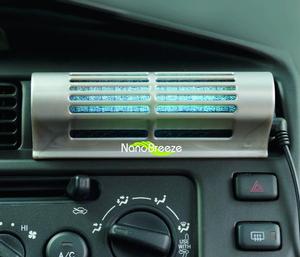
    nanobreeze The NanoBreeze Car Air Purifier from NanoTwin Technologies uses photocatalytic nanotechnology to clean and purify the air inside the passenger compartment of any motor vehicle.

    ... Nanotechnology is the design, manufacture or control of single molecules and atoms to perform the duties of a machine. The NanoBreeze Car Air Purifier uses crystalline molecules of titanium dioxide TiO2 as a molecular machine. TiO2 is a semiconductor charged by UVA photons to drive oxidation and reduction reactions on the catalyst surface. The reactions convert organic pollutants to carbon dioxide and water. The process is known as oxidation by photocatalysis, from combining the Greek words for light and dissolve. Even the American Lung Association reports that photocatalytic nanotechnology is capable of rapidly destroying toxic components of tobacco smoke such as formaldehyde, acrolein, and benzene. More
NanoBot Backgrounder
Is this nanotechnology?

NanoSecond


Newly designed nanoparticle quantum dots simultaneously target and image prostate tumors in mice (EurekAlert)

    Emory University scientists have for the first time used a new class of luminescent "quantum dot" nanoparticles in living animals to simultaneously target and image cancerous tumors. The quantum dots were encapsulated in a highly protective polymer coating and attached to a monoclonal antibody that guided them to prostate tumor sites in living mice, where they were visible using a simple mercury lamp. The scientists believe the ability to both target and image cells in vivo represents a significant step in the quest to eventually use nanotechnology to target, image, and treat cancer, cardiovascular plaques, and neurodegenerative disease in humans. The findings were published on-line July 18 in the journal Nature Biotechnology and will appear in the journal's August 1 print edition. More

    Related news here, here and here

Saying no to more EU regulation (Financial Times)
    The Commission can set the right framework for companies to compete and to prosper; it can also, unfortunately, contribute to de-industrialisation. We are faced with the situation that companies turn their backs on Europe and innovate elsewhere, although Europe could be a world leader in new technologies, such as gene technology, biotechnology and nanotechnology. More
Nanomedicine Breakthroughs at Xerox's PARC (Roland Piquepaille's Technology Trends)
    The new Scripps-PARC Institute for Advanced Biomedical Sciences (SPIABS for short) is the fruit of the union between Xerox's PARC and the Scripps Research Institute in La Jolla and promises to transform medical research and the practice of medicine. The Mercury News writes that it's making a big leap to innovation in medicine. SPIABS already announced an enthalpy array, an extremely precise nanocalorimeter. It can detect changes of millionths of a degree in temperature, using samples of only 240 nanoliters. More
Introduction to Nanotechnology is now online and free (NanoTechWire)
    This material was produced as part of a ten hour course designed to introduce the scope of nanotechnology. An introduction to nanotechnology is now online. The material for this course is now available for students, educators, and anyone wishing to know more about nanotechnology. More
Nano Additives From BYK-Chemie: First Application in the Field of PVC Floor Coverings (Inside Paint)
    The products are marketed under the tradenames NANOBYK-3600 and NANOBYK-3601. They have been developed to improve scratch and wear resistance of UV-coatings that can also be applied to plastics (e.g. as a top coat for Vinyl Floorings). More
ITRI develops new application for nanoparticles (eTaiwan News)
    Utilizing new advance in nanotechnology and the application of metal photo-catalyst, the government-affiliated Industrial Technology Research Institute has developed more efficient ways of filtering pollutants and purifying air to maintain health living conditions both at home and at work. More
Particle Chains Make Quantum Wires (Technology Review)
    Computers must have the ability to transfer data among different components. One of the difficult problems of building a quantum computer is finding a way to transfer data stored as a property, or quantum state, of an atom, electron or photon.

    Researchers from the University of Cambridge in England, the National University of Singapore and the Massachusetts Institute of Technology have devised a relatively simple way to transfer data between quantum bits, or qubits. More

Tuesday, July 27, 2004

Welcome to our Nano Nightmare - The Sequel


Memo to Intel: If "nanotechnology" was easy, everybody would be doing it. Thank goodness nanoscale self-assembly, atomically precise positioning and other nanotech tricks are coming to the rescue. Your father's clunky, old top-down lithography methods are going the way of the Oldsmobile.

    The final straw came last week, when Intel acknowledged that it was delaying the launch of a chip that it had called "the linchpin" in its new line of chips for notebook computers. That delay meant that computer systems built with the chip, which offered new audio and video capabilities, would miss the winter holiday shopping season. More here
NanoBot Backgrounder
Welcome to our Nano Nightmare
Thanks for the nanomemories, Intel
Thanks for the Nanomemories, Part II
Cut NSF, but grow nano

Related News
Nanoimprint lithography gets smaller

Political Science

kerry

"While the Bush administration has
politicized science, Kerry will put
America back on the path of scientific
excellence with a commitment to scientific
research based on fact – not ideology."
More

bush

"Nanotechnology research has been
a priority for the Administration
for the last three years. Overall
funding for nanotechnology research
has increased by 83% since 2001.”
More

Quantum Cocktail


While I applaud the attempt at metaphor, I'm not sure I understand it. Then, again, I keep waiting by my mailbox for cocktail party invitations.

    (David) Grier compares the light output, or "noise," of a blinking group of quantum dots to the babble of cocktail-party conversation. "Even if everyone's talking about the same thing, you probably wouldn't be able to figure out what they're saying," Grier says. "Matt has discovered that, for these blinking quantum dots, all the conversations are the same in a very special way. And that allows you to figure out an awful lot about what's being said by listening to the whole crowd." More here

NanoBot Backgrounder
Metaphors thinner than a human hair
Merkle and the case of the misleading metaphor

Monday, July 26, 2004

Pleasant Nannites


irobot

"Sonny, get the Nannites."
"Yes, Doctor"

Don't want to spoil it for those who haven't see it, but in I, Robot, nano is good.

NanoBot Backgrounder
Web-slinging Stepford Nano
The Amazing Power of PokéBalls
Crossing the Blood-Game Barrier


This blog will self-destruct in 5 seconds


Mission Impossible (U.S. News & World Report)

    Despite the opposition, the ODCI (Office of the Director of Central Intelligence) team did have some successes. ... Among the project areas: using nanotechnology to create microscopic electronic bugs that can penetrate terrorist camps, and development of sophisticated new data-mining software, dubbed Novel Intelligence from Massive Data. Even a scaled-back version of ICMAP is getting funded, says Charlie Allen, who took over the project when James Simon left in early 2003. Allen expects a pilot version next year. All it took, he says wryly, were 23 drafts to get the proposal approved by agency heads. More here.
NanoBot Backgrounder
Military, Media and Mishpucha
National Nanotechnology 'Disarmament' Initiative
'Integration' and 'Vision' at Michigan Small Tech

'Gee Whiz'


Thank you, Anita Campbell of Small Business Trends, who writes:

    Howard Lovy, the publisher of Nanobot, de-mystifies nanotechnology. At the same time, he revels in the "gee whiz" aspect of it. And he knows how to use the gee whiz factor to capture his readers' attention, along with some humor and wit thrown in for good measure. More here

The Princess or the Dragon


The promise and perils of the nanotech revolution (San Francisco Chronicle)

    Nanotechnology could revolutionize science, technology, medicine and space exploration.

    Nanotechnology could ravage the environment, eliminate jobs and lead to frightening new weapons of war.

    Those are two extreme takes on the hottest, and potentially most controversial, new technology since biotech and PCs. More

NanoBot Backgrounder
Apocalypse Nano
Are nanoparticle studies 'one decade late'?
Ruff on the environment

Sunday, July 25, 2004

The children are our nano future


Teacher conference examines cutting-edge technologies (News@UWMadison)

    The intersection among four major areas of science and technology and how to apply it K-12 classrooms will be the topic of a two-day conference beginning on Monday, Aug. 2.

    Teachers at the conference will explore a concept called "converging technologies" -- the combination of nanotechnology, biotechnology, information technology and cognitive science -- as a unifying concept in teaching science. More here

The next technological revolution? PSU-Fayette conducts nanotech camp (Daily Courier)
    Area high school students were introduced to the small, small world of nanotechnology this week during a special camp at Penn State Fayette The Eberly Campus.

    According to David Meredith, a professor at the campus, the nanotechnology program has been offered at Penn State for two years, and the camp is new this year to let potential students know what it is, how it works, where it's applied and why it's the next and possibly greatest technological revolution. More here

Extra class in science might not be answer (Star-Telegram)
    Sounds simple enough, considering the spread of high-tech and biotech and nanotech. But there's more to building a dynamic work force than dictating more classes.

    How about making sure that students get more from what they're already taking? More here

CBEN Wins grant for undergraduate nanotech course (PhysOrg.com)
    Class will present technical aspects alongside analysis of societal impacts

    The Center for Biological and Environmental Nanotechnology at Rice University today announced the award of a $100,000 grant from the National Science Foundation to develop the first introductory nanotechnology class to be offered at Rice University, a research-intensive institution known worldwide for its excellence in nanotechnology research.

    The course, titled "Nanotechnology: Content and Context," will be offered jointly by the departments of chemistry and anthropology this fall. The grant, awarded under NSF's Nanotechnology in Undergraduate Education program, allows Rice to join a small but growing number of schools offering undergraduate nanotech classes aimed at preparing students for a future in which nanotech is an integral part of the technology landscape. More here

NanoBot Backgrounder
Gonna send you back to nano schoolin'
Venezuelan natural nano resource
Do you know where your children are?

Cut NSF, but grow nano


The House Appropriations Committee apparently wants to see some cuts at the National Science Foundation (NSF) for 2005. Nanotechnology, however, appears to be one small exception. Judging from this quote provided by SpaceRef.com, "nanotechnology" in this instance means the semiconductor industry.

    Regarding nanotechnology, the report states, "the Committee remains concerned that researchers are reaching the physical limits of current complementary metal oxide semiconductor process technology and that this will have significant implications for continued productivity growth in the information economy." After commending NSF's activities, the report "encourages NSF to consider increasing research support, where feasible, through this program." More here

The House committee is likely reacting to a request from the Semiconductor Industry Association. In 15 years, the association predicts, it'll be like Midtown Manhattan subways during rush hour on every chip. You just can't pack them in there any tighter. Top down is dying. Bottom-up is on the ascent – whether it's through self-assembly or atomically precise positioning.

So, the group is asking the U.S. government to chip in more money and it's proposing a research institute that will discover what comes next. The goal? Creating an entirely new industry, with new switches, interconnects, materials, memory and manufacturing methods by 2020.

Related News
Chipmakers' Problems Are Speeding Up (BusinessWeek)

    Longer term, chip companies are looking at all sorts of exotic solutions, including more use of nanotechnology. Within the next decade, engineers envision using tiny carbon nanotubes as a partial replacement for silicon to cut down on chip overheating. Further out, scientists anticipate being able to make tiny transistors with single-atom switches, requiring infinitesimal amounts of energy to run. More here
Samsung Expands Texas Semiconductor Lines (The Korea Times)
    The enlargement represents the second-phase implementation of Samsung's three-year plan to invest $500 million in SAS to make the fabrication plant a world-class facility armed with so-called nano-technology. More here
Nano-Imprinting Promises Even Smaller Electronics (Science a GoGo)
    In a discovery that could lead to dramatically smaller computer chips and other electronic components, Princeton scientists have found a way to mass produce devices that are so small they are at the limit of what can be viewed by the most powerful microscopes. More here
NanoBot Backgrounder
Thanks for the nanomemories, Intel
Welcome to our Nano Nightmare
What Would Roger Own? Not Nano
Swatting Millipedes
Abstract Cart

Fools don't rush in


Is Nanotechnology for Real? (Motley Fool)

    Which companies will make the most of this field? So far, one has used nano-development to improve drug delivery -- boosting its stock price. But investors searching for commercial value from hundreds of other companies looking to improve products through this science will start down a long road. More here

NanoBot Backgrounder
Nanocap stock positions
Garbage picking
Return of the Cave Capitalist

Saturday, July 24, 2004

Nano Bacon Brought Home


Looks like the seeds planted by Oregon's governor and senator are beginning to produce a bumper crop. But NanoBot readers already knew they would.

University of Oregon lands millions of dollars in grants (Associated Press)

    Research programs also will benefit from $5 million in funding for the Oregon Nanoscience and Microtechnology Institute, a joint effort of the University of Oregon, Oregon State University, Portland State University, the Pacific Northwest National Laboratory and private partners. More here
DoD spending bill includes nanotechnology funds (EE Times)
    Congress approved funding this week included in a military appropriations bill to continue nanotechnology research at the University of Oregon.

    The Pentagon spending bill approved Thursday (July 22) included $8 million in nanotechnology research funding earmarked for the University of Oregon (Eugene). Of that total, $5 million will go towards continuing research at the Oregon Nanoscience and Microtechnologies Institute. More here

NanoBot Backgrounder
Oregon Trail and the Holy Grail
Mr. Kulongoski goes to Washington

Related Resources
Oregon Nanoscience and Microtechnologies Institute
Micro Nano Breakthrough Conference 2004
Portland State University Center for Nanoscience and Nanotechnology

Royal rulings


Scientists support Prince on nanotech (The Independent)

    Tough new rules must be brought in to guard against dangers to health and the environment from nanotechnology, Britain's top scientific and engineering bodies will conclude this week.

    A weighty new joint report by the Royal Society and the Royal Academy of Engineering will also urge ministers and scientists to adopt a much more open approach to the public over the technology than it has over GM. More here

NanoBot Backgrounder
'Societal Concerns' vs. Scientific Accuracy
British Equation
U.K. recognizes importance of perception

Upcoming Event
First International Symposium on Occupational Health Implications of Nanomaterials, 12-14 October 2004, Palace Hotel, Buxton, Derbyshire, UK. More here

Friday, July 23, 2004

A night at the micro opera


opera

Swinburne University of Technology's Centre for Micro-Photonics constructed a model of the Sydney Opera House. Its dimensions are 64 x 38 x 41 micrometers, (yes, I know; not nano, but cool, anyway). It was built from a hybrid material of glass and polymer. The opera house joins the White House, the Micro Bull, the nanosax, the nanoguitar and, of course, it all started with this IBM image. And you can't forget Venture Capital firm Draper Fisher Jurvetson's infamous hoax, the NanoCar. What does any of this do to advance the science of nanotechnology? Probably very little. But when it comes to attracting the interest of the general public, you know what they say about that picture/word ratio. The micro opera house was among Yahoo News' most e-mailed photos.

NanoBot Backgrounder
The Art of Nano
Stairway to Heaven
Human Nanofactory in Four Dimensions

SciFi 'drifting toward reality'


To boldly go . . .
Donna Shirley, who bucked sexism to become an aerospace engineer and went on to lead NASA's Mars program, now heads Seattle's new Science Fiction Museum
(Chicago Tribune)

QuoteBot


"The next generation may be so small that they could be put in our cereal packet and we may ingest them and be tracked without our consent."

Professor Ursula Gibson of Dartmouth College, quoted in Australia's ABC Science Online, referring to smaller and smaller tracking devices during a nanotechnology ethics debate

'Terabyte territory'


Mark Frauenfelder, BoingBoinger, freelancer and one of my correspondents in a previous life, quoted me in his latest column in the mobile Internet news site The Feature:

    To find out more, I spoke to nanotechnology expert Howard Lovy, the principal author of a new report on nanostorage that was issued this week by the market research firm, NanoMarkets.

    Lovy told me the one big advantage of MRAM is instant access. Compared to hard drives and flash memory, which are relatively slow, MRAM is speedy. It's not as fast as SRAM, but unlike SRAM, MRAM is nonvolatile, which means the data doesn't go "poof!" when the power is cut off. MRAM could give mobile phones a much-desired instant-on (and off!) capability.

    MRAM also uses a lot less power than solid-state memory since it doesn't have to be continuously refreshed. It only uses power when it is being accessed, and even then, it only needs a small amount. Another advantage is the ultra-high storage capacities that are achievable. "It brings us into the terabyte territory," says Lovy. Were talking not just your entire music library on a chip, but the entire Library of Congress on a sugar cube." More here.

NanoBot Backgrounder
Money for Memory
My 64-bits worth
Thanks for the nanomemories, Intel

Update: Engadget is running a new storage medium roundup. But, then, they blow it by being so hip and more cynical than thou that they fail to see the difference between real technology and chicken sh_t.