 Photo by Adam Keiper
Eric Drexler, far right, looks on as IBM's Don Eigler, second from left, describes molecular manufacturing as "speculation," "supposition" and "fantasy." At far left is Peter Cummings of Vanderbilt University. Sitting next to Drexler is Ralph Merkle of Georgia Tech.
By Adam Keiper
Managing editor of The New Atlantis,
Fellow at the Ethics and Public Policy Center, and …
NanoBot Correspondent
WASHINGTON, Feb. 10, 2005 -- Eric Drexler fathered the modern field of nanotechnology more than two decades ago.
Today, he presented his ideas to the committee tasked by the National Research Council
with studying America’s nanotechnology program. Now, as the committee returns from
a private lunch, it isn’t clear what they make of Drexler’s ideas – there was clearly
significant skepticism from some members of the committee, but Drexler's ideas were treated seriously.
Drexler’s presentation was an overview of molecular manufacturing. The heart of
his presentation was an animation
showing what a desktop nanofactory might look like. The purpose of
the animation, he said, was to demonstrate that molecular manufacturing was “not
nanobots … not goo …and not magical.” It would be a “deep and profound revolution,”
but not an unattainable one.
To draw a clearer distinction between his own vision of nanotechnology and that
of the government nanotechnology program, Drexler showed a slide depicting two fundamentally
different objects: a huge boulder and a small, delicate pocket-watch. The boulder
represents today’s nanotechnology, he said: “a nanoparticle of about 100 nanometers.”
The pocket watch represents the sort of nanomachine encompassed in his vision of
nanotechnology. To talk about the great potential of nanotechnology while only funding
research on conventional nanotechnology inflates expectations, Drexler said, and
makes the public “feel like there is hype in the system.”
Drexler admitted that there is of course an enormous “implementation gap” between
our present tools and theories and those needed to achieve molecular manufacturing,
and he warned that the gap couldn’t be bridged under current National Nanotechnology Initiative (NNI) policies. His take
on the government’s approach to molecular manufacturing: “Not only are they [the
NNI] not doing it, but they have been discouraging it.” He contrasted this with
other governments, saying that the U.S. has a number of “known international competitors,”
and mentioning that India’s president recently cited Drexler’s book "Nanosystems."
(He didn’t mention, though, that there is no clear reason to think this foreign
competition is doing serious work yet.)
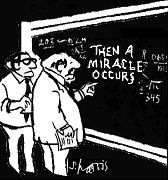
Soon after his presentation began, members of the committee – biologists, chemists,
physicists, and assorted men and women from industry and academia – engaged Drexler
with critical questions about his basic theories; Drexler, in crisp sentences, responded
to each question carefully. Committee member Paul Schaudies, for instance, a microbiologist
from SAIC, pointed out that we don’t understand how cells work – “there are a whole
lot of little boxes here that say, ‘A miracle happens here’” – so how could we possibly
solve the questions required to develop molecular manufacturing? Drexler’s response:
“Engineers deal with the knowns,” so it won’t be necessary to solve all the mysteries
that pure scientists might want to solve.
Drexler’s solo presentation was followed by a panel discussion featuring Drexler,
Don Eigler of IBM, Peter Cummings of Vanderbilt University and Oak Ridge National
Labs, and Ralph Merkle of Georgia Tech. Eigler is best known for his arrangement
of 35 individual xenon atoms to spell out the letters “IBM” in the 1980s. (“I suspect,”
he said, “that I am the only one you [the committee] will hear from that has physically
assembled a molecule using techniques other than biology or chemistry.”) He launched
a blunt criticism: “Molecular manufacturing belongs in the realm of what I would
call supposition, or speculation.” He drew an analogy to the ancient Greeks' speculating
about human flight using feathers and wax. “What we do not need,” he said, “is an
Apollo Project for molecular manufacturing.”
Drexler objected to Eigler’s use of “charged language” – words like “speculation”
and “fantasy,” which “will not encourage people to come forward” with proposals
related to molecular manufacturing.
Peter Cummings, speaking in clipped sentences with a strong Australian accent, described
his study of fluctuations that might pose difficulties for molecular manufacturing
– fluctuations that might, for instance, cause nano-machines to run backwards. But
he conceded that “this is not a showstopper” for molecular manufacturing.
Ralph Merkle argued that, in order to develop molecular manufacturing, “What we
lack at this point is the will ... to be bolder in what we’re willing to consider.”
The panel ended with questions from the committee about what concrete proposals
would constitute reasonable next steps toward the development of molecular manufacturing.
What would you do, one committee member asked the panelists, “if you had unlimited
resources?” The only answer came from Drexler, who argued for improvement of the
tools that would be required or molecular manufacturing, demonstrations of assembly
and motion of nanosystem components, and the development of a “first-generation
machine” similar to a ribosome.
During the lunch break, as the committee met behind closed doors, the government
officials who started off the workshop yesterday – U.S. nanotech head Clayton Teague and White
House technologist Celia Merzbacher were spotted sitting down to a lunch with several
leading figures from the pro-molecular manufacturing camp, including Drexler. Now,
after lunch, the committee has reassembled and is hearing about the current state
of the art in nanotech research.
 "It seems that the appeal of loveless sex to the average coed is its convenience. It requires the commitment of a De-Cal instead of a five-unit lab course. But would you rather study the social commentary in The Simpsons or the practical applications of nano-technology in the 21st century? Does the "easy way out" mean it's less rewarding? That, ole chum, is up to you. Another old professor trick: make all complicated questions rhetorical."


