Sunday, April 08, 2007

Customers Googled while newspapers burned

Where are news advertisers going? Follow the money. My latest Michigan Business Review column can be found here. Or you can read the original "writer's cut." Here's an excerpt from the full version.

So, while advertisers are flocking to Google, Yahoo and other local search providers like yellowpages.com, most newspapers still relegate "online" to some curious little tech trend that they really should learn more about, eventually. It amazes me, at times, how an industry that is supposed to be writing the "first rough draft of history" is today still clinging possessively to their buggy whips while their customers zoom past them on horseless carriages. And when it's time to shed employees, a nebulous concept like "the economy" is blamed. No. That's not it at all. Follow the money. The ad dollars are being shifted to where advertisers can reach their customers at a cheaper price. More here
Related news
"Electronic paper" edging toward reality
AOL launches search ad service with Google
Google tests directory assistance for phones

Wednesday, April 04, 2007

Steve Jurvetson on revolution within and without

Visionary venture capitalist and, of course, NanoBot reader Steve Jurvetson took a few seconds out of his normal routine of firing off really cool model rockets and helping to fund the technological revolution to drop me a quick note here to tell me that he posted a reply here to my comments about revolution from the outside vs. the inside here, which promoted my blog post and column about Tesla Motors, electric vehicles and an ethanol economy, which teased to my Q&A interview with Tesla Motors CEO Martin Eberhard -- excerpt here, full transcript here. Oh, what a tangled World Wide Web we Weave.

Wednesday, March 28, 2007

PBS station gives us nanoriches


KQED-TV goes on a Nanoquest and comes up with pages and pages of great information, video and photos. Watch, enjoy, learn.

Backgrounder
Info in a nanoshell
NANO on NewsHour

Friday, March 23, 2007

Jim Carrey and Conan talk quantum physics II

I see that a great many readers are searching for a clip of Conan O'Brien and Jim Carrey chatting about quantum physics. I posted the clip a few weeks ago, courtesy of YouTube. But I see that NBC has pulled the plug. So, I've saved it onto my own server. Click above or here to download the clip. Enjoy.

Update 12/7/08: The video can now be found here.

Monday, March 19, 2007

Nanotech for undergrads

There are some admirable goals in the National Science Foundation's funding for Nanotechnology Undergraduate Education in Engineering. They're placing it in the context of overall improvement in science literacy (which U.S. students, especially, could use if future generations have any hope of competing with the Ph.D.-rich China and India), and it helps universities get used to the idea of multidisciplinary cooperation. Here's an excerpt from the NSF's program solicitation. Universities, get yer red-hot nano money. But hurry, supplies are limited. Offer good until June 18.

"Advances in nanotechnology research provide new opportunities in undergraduate education. With their focus on imaging and manipulating the atom, the ultimate building block of matter, nanoscale science and engineering provide a multitude of new interdisciplinary teaching opportunities for engaging interest and for broadening vision by students of science, engineering, and technology. Nanoscale science and engineering thus permit new strategies for enhancing science and engineering literacy, preparing the workforce for emerging technologies, and attracting a diverse group of talented students to the workforce of tomorrow. The FY 2007 solicitation is focused on nanoscale engineering education with relevance to devices and systems, and/or on the societal, ethical, economic and/or environmental issues relevant to nanotechnology." More here

Classic Dave Barry on the space elevator

Ted Semon, (tee-hee! oh, grow up, Howard!), who operates the Space Elevator Blog, found my old, dead link to Dave Barry's mock treatment of the carbon nanotube cable-to-the-stars idea. Semon swam around the Internet until he found this PDF of the classic Barry send-up.

Backgrounder
Google Earth gives 'space elevator' a lift
Buy-in-the-sky scheme
Space Elevator: The Music Video

NanoVox

Nanotechnology voices: My favorite comments, of course, come from the children. Enjoy.

Backgrounder
Nanotech hocus group
Government Created Killer NanoRobot Infection
Pinhead Angels: The Video

Friday, March 16, 2007

Veni, vidi, vici Wiki

In my column this week at Michigan Business Review, I complain about the way Wikipedia is going. Turns out, it's becoming just another old-school encyclopedia and not the complete source of human knowledge that I had hoped it would become. There are many reasons for this, but one of them is the surprising short-sightedness of Wiki's moderators -- an example of how just a little knowledge is a dangerous thing.

I almost spit out my coffee this morning when I listened to a podcast produced by some of Wikipedia's moderators. They were complaining about some of the "trivia" now cluttering up what they consider to be the wonderfully complete entry on the life of JFK. I had to laugh out loud at the thought of a few geeks behind their computers (you can actually hear them clacking away in the background during the podcast) who, armed with their Internet search engines, presumed themselves to be qualified to determine what should be dismissed as "trivia."
And, speaking of trivia, longtime NanoBot watchers might recognize my own teeny-tiny contribution to Wikipedia.
My own personal 15 nanoseconds of fame on Wikipedia can be found in the entry for the National Nanotechnology Initiative. The page says: "President Bill Clinton advocated nanotechnology development. Howard Lovy, a nanotechnology writer, said the Initiative may 'turn out to be one of Clinton's most-important legacies.'"

Here's how that came about. I was at Birmingham's Baldwin Library a couple of years ago making use of the free Internet connection to get some work done. I took a break, stretched and noticed Clinton's autobiography in the new books section. I was surprised to find that Clinton, himself, hardly mentioned his launching of the initiative.

So, I wrote the statement above in my nanotech-themed blog. I was qualified to make the statement, as I had spent the previous three years or so covering nanotech full time. Although it could be argued that I'm not a historian nor a scientist, so what gives me the right to make such a claim and Wikipedia the right to list it as a credible source?

Well, the wonderful thing about history is that it marches on. And we'll see. More here

Backgrounder
Clinton makes nanomention of large legacy

My interview with Tesla Motors CEO

As promised, my interview with Martin Eberhard, CEO of Tesla Motors, ran in this week's Michigan Business Review. Eberhard is out to create nothing less than the next Great American Car Company. He just might do it, too. Here's the intro to the Q&A-style interview.

Martin Eberhard believes in the innate desire of that unique and peculiar animal - the American automobile driver - to do the right thing and own a vehicle that does not contribute to global warming and deplete natural resources.

But Eberhard also knows that the history of the past 30 years has revealed another inherent truth about the U.S. species of car consumer: The "doing the right thing" instinct is almost always subordinated to an even stronger natural urge... to own a really cool ride.

Enter Tesla Motors Inc. - Eberhard's luxury electric-car company that he co-founded to reconcile this "id vs. superego" war over hearts and minds of automobile consumers. Eberhard believes that his company is here to provide some much needed therapy for this era of bad feelings over the pollution produced, energy wasted - and not to mention jobs lost - in the U.S. auto industry. And he's doing his part on the jobs front, too, as his growing company is poised to open up an engineering center in Rochester Hills and hire about 60 engineers.

The Rochester Hills staff will work on what's next after the much-publicized Tesla $90,000 roadster. Right now, it's code-named Project White Star. And while this next all-electric vehicle will not exactly make it affordable for everybody to do the right thing - this one will set you back about $50,000 - it is a step in the right direction toward Eberhard's ultimate goal: creation of the next great American car company. And he wants to get there before the old fossil fuel museum pieces wheeze out their last.

Oakland Business Review technology and manufacturing reporter Howard Lovy caught up with Eberhard recently and talked to him about the Rochester Hills plant, along with subjects ranging from the skills workers need to the "ethanol economy" to the challenges of almost literally reinventing the wheel. Here's an edited transcript of their discussion. More here

Backgrounder
Who's driving the revolution?

Friday, March 02, 2007

Who's driving the revolution?

Those who follow nanotech business models are probably already familiar with the theme in my column this week at Michigan Business Review. I discuss when it no longer makes sense to change industries from the inside by developing products that are easily integrated into current products and processes.

Under some conditions -- for example, if market demand or technological progress outpace the ability or willingness of an industry to adopt change from within -- there comes a point when it is time to let the old ways simply implode under the weight of their own inadequacies and begin anew -- from the bottom up.

I live in the Detroit area, where this implosion is experienced in painful slow motion, one auto company and supplier at a time. I contrast venture capitalist Vinod Khosla's support of an ethanol economy as a way of changing the auto industry from within with the more-revolutionary strategy of Martin Eberhard, CEO of the electric car company Tesla (no, not the '80s hair band of the same name!).

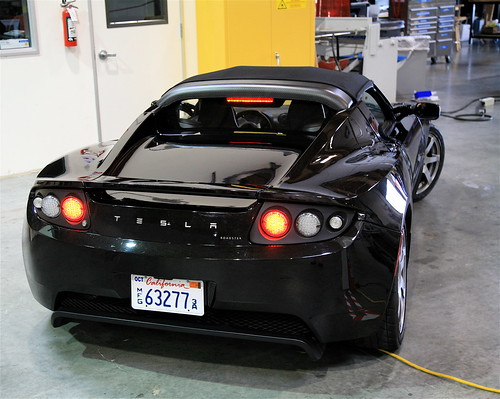
Above, of course, is a Tesla automobile courtesy of nanotech venture capitalist Steve Jurvetson, who gets to have all the fun by driving one. I got to do the next best thing, I guess, and interview Eberhard. A Q&A-style transcript of the interview will run in a future edition of the Michigan Business Review.

And, speaking of changing industries from outside, take a look at my feature of a media revolutionary in the form of a mommy blogger.

Meanwhile, here's an excerpt from my column that might interest nano watchers.

Both Eberhard and Khosla come to their conclusions via the prism of Silicon Valley, whose major industry is facing its own impending extinction. The year 2020 is the absolute drop-dead date where current lithographic methods will no longer be able to keep up with market demands in chip size and power (for the geeks among you, this is the limit of Moore's Law).

So, IBM, Intel and others are using everything in their bag of tricks to get the most out of outdated methods, but are only now realizing that they are going to have to rip up the entire foundation and begin building their industry all over again - from the bottom up.

Waiting in the wings are a number of nanotechnology companies preparing for the day that they will come forward to become the "Next Intel," with true game-changing solutions.

Eberhard might not have the big solution. Tesla might not become the "Next GM." But I do know Eberhard is on the right side of the dividing line between the old world and the new. More here

Update: Many thanks to Mike Magda of AutoblogGreen for his accurate summary of my commentary and the debate that follows.

Backgrounder
Revolutions happen to the unprepared

Wednesday, February 28, 2007

mPhase takes its power to the people

During my short, less-than-meritorious career as a nanotech pitchman over the course of the last couple of years, here's one recurring theme I tried to get across to employers and clients: Public relations is no longer only a matter of begging major publications to write about your company. RSS and cheap distribution of videos like the one above are the great equalizers.

Companies can produce messages themselves, bypass traditional media and take their message directly to their audience. That is exactly what mPhase has done here with a video about its nanobattery, and in this one released a week later on its magnetometer.

I had no takers on my proposals, along with other strategies that made use of "bottom-up" citizen-enabled media -- largely because most of the companies I worked with, in the end, were just not ready to take the next step. mPhase took a chance and, with 13,312 views so far, and the discussion continuing on YouTube and other sites, this no-brainer concept is more than proven. You just can't get better PR for the price. I'm glad at least one nanotech company finally "gets it."

Backgrounder
My other life as a nanotech pitchman
March goes out like a Li-Ion

Monday, February 26, 2007

Jim Carrey and Conan talk quantum physics

OK, all you real quantum physicists out there (and I know some of you are indeed closeted NanoBot readers), are Jim Carrey and Conan O'Brien saying anything that makes any kind of sense here (at least, as much sense as can be made in quantum physics)? And is Max Weinberg really wrong?

Update: NBC turned out the lights on the YouTube clip, but click here for links on my server.

Backgrounder
Einstein's dice and the nano Sopranos

Friday, February 02, 2007

A sneak peak at next week's quantum leap

Thanks to nanotech venture capitalist Steve Jurvetson, we get a sneak peak at the core of a new quantum computer, which will be lovingly unveiled a day before Valentine's Day -- Feb. 13. Yes, you read that correctly. There is real work going on in the mind-boggling multiverse of quantum computing, where a shave and a haircut can cost anywhere from one to 65,536 bits (or qubits) at the same time.

I remember when Jurvetson's firm first invested in D-Wave Systems Inc. back in 2003. I was news editor at Small Times back then, and we just ran a brief on it because even we -- who had chugged the nano Kool-Aid -- found it difficult to believe that a quantum computer would be anywhere close to commercialization.

I also remember my surprise at Jurvetson's investment, since he has long maintained that while he's a believer in the long-term promise of molecular nanotechnology, come to him for money only if there's a short-term commercialization plan.

I should know better than to doubt Steve Jurvetson, who consistently proves the truth of a phrase credited to Alan Kay, whose work at the Palo Alto Research Center in the 1970s can be traced directly to the computer revolution of a decade later. "The best way to predict the future is to invent it."

Or, in Jurvetson's case, to fund it.

Backgrounder:
Einstein's dice and the nano Sopranos

Wednesday, January 31, 2007

A fat Pfizer pushed away the pioneers

My column this week over at Michigan Business Review discusses the Pfizer plant closings that have caused a great deal of trauma in local communities. I blame Pfizer for refusing to live up to its end of the patent-cycle bargain and refusing to look at the work of those who are truly pushing the boundaries of medicine, including nanotech pioneers here in Michigan. Here's an excerpt:

Instead, there pervaded a culture that gave collective shrugs against those who pushed the frontiers, against those who were developing methods of avoiding the kinds of side-effects that gave Pfizer and others such a black eye a couple of years ago. Remember Celebrex and Vioxx? So, most experimental therapies were shown the door.

...

I am thinking of companies like Ann Arbor’s NanoBio Corp. or Avidimer Therapeutics Inc., both companies spun out of the nanotech labs of the University of Michigan’s James Baker, and both working on the next generation of targeted, timed cancer therapies that could do away with painful chemotherapy.

Last year, when Pfizer began trimming its Ann Arbor workforce, Baker told me that there was an exciting ‘’critical mass’’ of people in Ann Arbor available to help his companies -- people who know the pharmaceutical business and can help with process development, clinical and regulatory issues, toxicology and other aspects of the business.

I also think of Donald Tomalia, a former Dow chemist who now heads Dendritic Nanotechnologies Inc. in Midland. His company is also working on a whole platform of potential game-changing anti-cancer compounds based on an invention he had more than 20 years ago. He told me that large pharmaceutical companies are finally realizing that their pipelines are empty even as their blockbuster drugs are coming off patent.

Now, almost a quarter-century after Tomalia’s invention of the dendrimer, the doors to Big Pharma are at last being opened for him.

Read the whole column here.

Update: Family ties bring good fortune to John Wu. And he wants to extend his "family" to former Pfizer workers looking for opportunities in China. Story here.

Friday, January 26, 2007

Cambridge fooled by nano hype

Nanotechnology 'has turned into a big business so quickly that few are monitoring nanotechnology's effects on health and the environment," says a resolution in Cambridge, Mass., instructing the city manager to look into regulating nanotech.

Sounds to me, again, like "nanobusiness" is the victim of its own hype. Nanotech is not big business. There's a great deal of promising science, a few high-risk investments, a whole lot of nanoscale snake oil masquerading as nanotech. But, as of yet, no big business.

Nanotech investment hypsters, however, have successfully created the illusion that it's big business in order to attract more investment. The only thing it's really attracted, though, is threatened regulation.

Backgrounder
When nanotech 'industry' believes its own PR ...
Nanotech's real danger is the nano con

Thursday, January 25, 2007

Smalls to The Wall


That's me, NanoBot Smalls, my avatar in Second Life. And as it is in my "first life," my Second Life self kept walking into walls. So, I decided to park myself in front of a virtual wall that contains more meaning -- a replica of the Western Wall in Jerusalem. And there I sit, deep in virtual contemplation.

And, while you ponder that, ponder this, my report on Second Life for Michigan Business Review.

Among my sources are Clay Shirky, an author who has followed every virtual fad since 1993. Clay gave me some wonderfully cranky criticism.

And as a counter to Clay, I also talked to Jack Mason. Longtime NanoBot watchers might remember Jack as one of my best correspondents for Small Times. Well, our boy Jack is all grow'd up now and working for IBM. I was pleasantly surprised when our worlds collided and I had an excuse to call him. Jack is in charge of IBM's Virtual Connection Center on Second Life.

Posted by Picasa

Monday, January 22, 2007

Government Created Killer NanoRobot Infection

From NanoBot

I sing the auto body electric

Now that I've narrowed the region, but broadened the scope, of my coverage, I'm still finding myself dipping into my nanotech experience as I cover a broad array of topics -- primarily involving the late great auto industry here in Detroit.

In my column at Michigan Business Review this week -- yeah, it's called TechTonic, just couldn't come up with anything better -- I discuss the "story behind the story" of General Motors' decision to revive the electric car, along with some news of local interest involving Ford's renewed investment in six Michigan auto plants to convert them to "flexible manufacturing" facilities.

I think it all comes down to the spirit of Henry Ford at last returning to Michigan. The idea is not just to make cars, but to own the frame, or template, onto which all current and future cars will be modeled. I learned this through my coverage -- from the inside and out -- of the pharmaceutical industry, where the goal is not to come up with the next blockbuster drug, but rather to invent the "drug delivery vehicle" that carries any one of a number of targeted, timed drug therapies.

I did not include this in the column, but I also think of Donald Tomalia and his dendrimers. Tomalia, also a Michigander, has ever since he invented the tendriled molecules a couple of decades ago at Dow, always dreamed of a kind of Periodic Table of Dendrimers, where his molecule can serve as the basic frame for almost limitless possibilities and products.

Must be something in the Michigan air that gives us delusions (aspirations?) of grandeur.

Google Earth gives 'space elevator' a lift


Stretching the meaning of Google Earth, a community of believers has marked the spot where, so sayeth the faithful, nanotubes will rise.

Backgrounder
Space Elevator: The Music Video
Got the world on a string
Buy-in-the-sky scheme

Saturday, January 13, 2007

Motown goes electric

Chrysler, GM go back to the future. Read my coverage of the North American International Auto Show media and industry previews here.

Pictured above is GM's all-electric Volt concept car. And at right is, well, I just love Italian cars, don't you?

And flip through my blogger's notebook with:

Toyota pours a little cold water on ethanol (video)
The guys who love their parts
Famous racing commentator buys a sandwich
All this and the Sync, too
Who resurrected the electric car?
And more

To tell you the truth, I do not get all that excited over cars. But all the technology that's being embedded everywhere in today's autos. Now that's pretty exciting.

The Big Three is now the Big Four, and there is still no public transportation to speak of in the Detroit area. The auto may be on the decline, but it's still king.

More later and, yes, nanotech too. Thanks for your patience.

Sunday, January 07, 2007

Blogging the Detroit auto show

Please be patient, nanobot fans. Nano blogging will return. Meanwhile, I'm in Detroit, blogging the 2007 North American International Auto Show, amid some horrible news in the auto industry. But, yes, a company actually WANTS me to blog for a change. Here's my first installment.

Chrysler's LaSorda likes bread and butter

And here's a feed to get you there via the portal of your choice.

Update: Video here and a new all-electric concept vehicle here. Or start from the beginning here.

Friday, December 22, 2006

Sniffing out some local stories

Please stand by, more blogging to come. There has been a great deal of nanotech news to comment on recently, but I'm holding my tongue for now. Meanwhile, just as a side note: As the above photograph indicates, it's kind of a relief to be working again for a paper publication, where your words can lend some inspiration to any occasion.

Thursday, December 14, 2006

Career stabilizers deployed

My career has traversed through many twists and turns and has met with too many dead ends and blind alleys over the past few years. Therefore, it is refreshing for me to get back to basics. I am a reporter covering technology and manufacturing for the Oakland Business Review in suburban Detroit. And, like my own career, the story of Metro Detroit is one of continuous change that must be met with continuous adaptation in search of stability.

This blog will remain devoted to nanotech, and I will likely launch a new blog devoted to my new beats. But, as a preview, here is a snippet of one of my first stories for the Business Review.

In a drizzle-drenched parking lot attached to a dull block of buildings on an aesthetically challenged warehouse side of the tracks in Ferndale, Scott Thornton shows a new driver how to fire up the comparatively colorful two-seater he says he's about to churn out of his factory by the hundreds.

The key turns. And ... "click."

Yes, that's "click." Not "vrooooomm, purrrr!" Just "click," and the engine is "running." Can't even call it running, really. It's just ... on.

Thornton points out the "gas gauge ... or, electricity gauge," correcting himself. Wiper, fan, radio and a mysterious black button. Press that baby, and the hot little neon-lamp of a car kicks into a "turbo boost," of sorts, doubling its speed.

But don't expect to feel any cheek-rippling g-force. The speedometer goes up to 80 kilometers per hour (about 50 mph), but the top speed on the Kurrent electric vehicle is 25 mph in Michigan, by law. And the engine is programmed to go no faster.

Laugh all you want, but while the old internal combustion-based auto companies eject workers out the exhaust, Thornton says his company is about to fill his factory with 50-70 new employees, assembling pieces of the energy future. More here

Friday, December 08, 2006

Back to Life: Cubicled

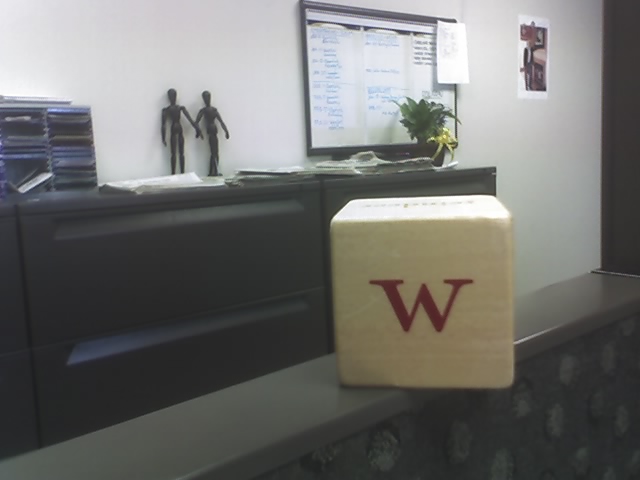
My son thought the letter W would come in handy at work. I think he's right.