You click, you buy |
|
Friday, February 27, 2004
Abstract Cart

News in a NanoSecond
You click, you buy Science at the Bar: Law, Science, & Technology in America
|
|
Thursday, February 26, 2004
Carlo's just a Copycat
|
I've had Carlo
Montemagno on my mind the past
couple of days, partly because he made the news recently with his
spectacular microcyborg,
and partly because I'm working on a Small Times magazine
column that incorporates some of his work. I'm in geek heaven when I
take the time out from various duties just to go through some of my old
interviews with brilliant people like Montemagno who, to paraphrase ZZ
Top, not only got knowledge, but know how to use it. The winner of the 2003 Foresight Institute Feynman Prize in Nanotechnology is really just a big copycat. He's obsessed with imitating nature. I can't blame him, really, since nanomachines are all around us, just waiting for magicians like Montemagno to figure out how they work. In addition to his incredible achievement in making a microrobot move by muscle power, Montemagno is working on another project that might not make for such spectacular headlines, but in the long run will make a bigger splash in the world. I'll roll the tape and give you a peak into Montemagno's mind. Last fall, I gave him my usual prelude about how I try to write to a lay audience, and I thought his answers were beautifully understandable. But I made the mistake of calling him a "science guy," so he quickly interrupted to set me straight:
Me: So, what's the end game for you? Montemagno: My end game is focused on making devices that have embedded intelligence and which, the component pieces, when I put them together, the functionality is greater than the functionality of the individual pieces. ... I take all these building blocks and I put them all together and these building blocks, by the interactions with one another, they elicit properties which are not manifest by any individual building blocks. It's the difference between pressure and molecular reaction. At the nanoscale, pressure doesn't exist. Right? Molecules bang into one another. In the aggregate, pressure emerges as a result of all these molecules banging together. And there are numerous properties which emerge, particularly in biological systems, as a result of these molecules all interacting together that reveals sophisticated behaviors. Me: Can you give me a practical example? Montemagno: The example that I'm most focused on
right now is making
nanosize particles that transport information very much like neurons
do. How do I do that? I take a membrane, an engineered membrane which I
make, I take some molecules that allow the flow of calcium or
potassium, I take another molecule that pumps potassium, and I put them
all together. When I put them all together, what happens is
collectively they generate an electrical signal. If I do it properly,
they'll make an oscillator and they'll keep on pumping the signal. But the parts don't do that. It's something that emerges as a result. I see that as a tableau for trying to make embedded materials, or smart materials. The smartness is part of the way the molecules interact with one another.
He told me that he's reached a level in the lab where
molecules are sorted and protons pumped. The next stop, and relatively
soon, is commercialization. What kind of useful product will come out
of this mess-o-molecules? The scientists among you probably already
know. But for the rest of you, that's a story for another day ... Related Posts |
|
News in a NanoSecond
You click, you buy Polyoxometalate Chemistry:
From Topology via Self-Assembly to
Applications Self-Assembly Monolayer
Structures of Lipids and Macromolecules at
Interfaces Troubled Pleasures :
Writings on Politics, Gender and Hedonism |
|
Wednesday, February 25, 2004
The Amazing Montemagno
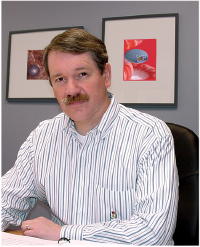
 I've written about UCLA's Carlo Montemago here, and he continues to amaze. I've written about UCLA's Carlo Montemago here, and he continues to amaze. At right is a picture I took (all rights reserved, etc., etc.) of Montemagno giving his Foresight Institute Feynman Prize in Nanotechnology acceptance speech at a conference last October. Now, Montemagno has made a microrobot move by muscle power. According to the New Scientist:
Montemagno now wants to use the technology to help people who have damaged phrenic nerves. These stimulate the diaphragm to make us breathe and damage means patients often need ventilators instead. Rather than moving the legs of a musclebot, the muscle fibres would flex a piece of piezoelectric material and generate a few millivolts to stimulate the phrenic nerve. Using cells from the patient's own heart would prevent rejection of the implant, and the muscle could be powered by blood glucose. Montemagno's initial brief from NASA's Institute for Advanced Concepts was to design a muscle-powered micromachine that could seek and repair micrometeorite punctures on spacecraft. |
|
Oregon Trail and the Holy Grail
From BendBulletin.com, an update on Oregon Gov. Ted Kulongoski's quest for one of 10 Holy Grails -- a vessel in which to store federal nano funds. When last we left our nano-knight-errant, the adventurer reversed the Columbia River course followed by Lewis & Clark, Woody Guthrie and others to seek the favor of rulers in the Eastern lands. The Bulletin's Andrew Satter reports:
... Kulongoski said that boosting Oregon's technology industry, with an emphasis in nanotechnology, is at the forefront of his long-term plan for bringing the state economic stability and job growth. "If you get the seed capital in for this nanotechnology and get designated, my belief is that these broader investments will continue to flow into the state, and Oregon will develop in the western part of the United States as one of the leading centers for nanotechnology," he said. More background here. |
|
News in a NanoSecond
Tuesday, February 24, 2004
Mr. Kulongoski goes to Washington
According to the Stateman
Journal of Salem, Ore., Gov. Ted Kulongoski plans to ask "Bush
administration science officials" that his state get in on federal nano
dollars.
Kulongoski doesn’t expect an answer today, but he said, “If you don’t show up, you can’t get in the queue.” Update: And this just in from The Oregonian. Scientists scramble to gain footing in the burgeoning field of nanotechnology" Related Stories at Small Times Oregon, My Oregon
Free Money from the Federal Government for Small Businesses &
Entrepreneurs
|
|
Monday, February 23, 2004
Nanoscience writers as lab rats
A project at the University of South Carolina's center for societal and ethical implications of nanotechnology (Thanks, Jack):
The science of the study of the popular perception of the study of nanotechnology has truly arrived. Common Thread: A Story of Science, Politics, Ethics
Human Genetic Information: Science, Law and Ethics - Symposium No. 149
|
|
Sunday, February 22, 2004
News in a NanoSecond
Rethinking Risk and the Precautionary Principle |
Journal recants publication of autism study
For those who read my Small Times column on this topic, here's an update via The Seattle Times. Another update from BBC News:
His comments came as the General Medical Council prepared to open an investigation into the way Dr Wakefield carried out his study. Meanwhile, Prime Minister Tony Blair has urged parents to have their children vaccinated. Autism Spectrum Disorders
Asperger Syndrome or High-Functioning Autism?
Curious Incident of Dog in Night-Time
Immunization Safety Review: Measles-Mumps-Rubella Vaccine & Autism
|
Saturday, February 21, 2004
News in a NanoSecond
|
Friday, February 20, 2004
DoE, EPA in MOU
The U.S. Department of Energy and the Environmental Protection Agency recently signed a "Memorandum of understanding (PDF, 70KB) on cooperation in research to protect human health and the environment." Here are some excerpts that might be of interest:
Another goal:
|
|
Educating the Regulators
"Regulatory Opportunities" from the NanoBusiness Alliance and Preston Gates Ellis & Rouvelas Meeds LLP:
|
|
Nanotech Meetup
Here's a new one to me: Nanotech Meetup -- Calling all Nanotech Enthusiasts Apparently it's the third Thursday of every month. Is this a Friendster-style networking thing? |
Thursday, February 19, 2004
Nano Goulash
Robin Green went to a public seminar on nanotech in the U.K. and filed this thought-provoking report on nano-ethics, Drexlerian nanotech, public perception and a frustratingly "low level of understanding of nanotechnology amongst the audience." Interesting stuff, how fact, fiction, politics and perception are tossed into the nanopot, producing a sour soup indeed. |
|
News in a NanoSecond
- Multiple choice question. Nanotech: threat or menace?
- World's largest scientific society launches kid-friendly chemistry Web site
- More nano in space
Rockin' Iranian Nanobots
| I think James
Joyner is on to something here.
I’d probably read a good blog on Iranian nanobots that cover local restaurant bands. Well, here are a couple of places you can go to see if there's any interest. Related Posts Music of Iran I Music of Iran II |
|
Wednesday, February 18, 2004
Nano Snake Oil?
Syntrax Methoxylon "with Nano Dissolution Technology. ... Potent for gaining muscle, losing fat, and increasing vitality, well-being and endurance. Also useful in supporing strong, healthy bones, and maintaining low cholesterol levels."
Nano work, if you can get it
Lockheed Martin is looking for a college student intern who "should be pursuing a Chemical Engineering degree and have knowledge of carbon nanotubes and polymer materials." And Millipore needs a technology manager for "nanoscale processing solutions."
News in a NanoSecond
Green Ink: An Introduction to Environmental Journalism |
|
Tuesday, February 17, 2004
Feynman was not for first-timers
In response to my request
for former students of Richard Feynman, Sydney Smith (aka medpundit), writes:
The problem was that you had to already have a good grasp of the subject to get anything from Feynman's lectures. The consensus among students who were new to physics (i.e. "physics-for-poets" students) was that it was hard to learn anything from him for the first time. Which backs up Feynman's own observation about his teaching. Surely You're Joking, Mr.
Feynman! (Audible.com)
Surely You're Joking Mr. Feynman!: Adventures of a Curious Character
(eCampus.com)
|
|
Monday, February 16, 2004
Do no harm: Don't forget Freitas
| Hello, Howard,
I'm Robert Freitas, author of the Nanomedicine book series (along with many other works relevant to molecular nanotechnology).
My recent book "Nanomedicine, Vol. IIA: Biocompatibility" ( ) is the first technical book ever written on the subject of the biocompatibility of nanomaterials and nanostructures in the human body. This scholarly work includes over 6,000 literature citations. Admittedly, the focus is primarily on the biocompatibility of diamondoid materials such as might be employed in medical nanorobots (e.g., diamond, graphene, fluorocarbon, sapphire, etc.), and on various other de novo issues related to a future medical nanorobotics technology (that nobody has ever thought about before) such as motile particle mechanocompatibility. But I also included in the book several sections on the biocompatibility of more conventional materials such as carbon nanotubes, dendrimers, DNA (such as might be used in devices built by Nad Seeman), along with discussions of more conventional biocompatibility issues.
It is still in print, available for purchase at Amazon.com, but only in softcover because the hardcover edition sold out its entire printing quickly, a couple of years ago. Please note: NMI is also freely available online in its entirety at my nanomedicine.com Website (which I own). I don't think you'll find any other nanotech technical books online. My book, and my publisher, are unique in this regard. I want to encourage dissemination and discussion of my vision of the future of medicine. In case your reviewer copy of NMIIA has somehow gotten lost, you can check out the entire Table of Contents of the book at http://www.nanomedicine.com/NMIIA.htm, and I anticipate the entire book will be up online (just like NMI) sometime in the next two months or so (just as soon as I can get to it). For future reference, later this year (probably around late summer or early fall), my next book, co-authored with Ralph Merkle and also published by Landes Bioscience, will hit the streets. The title is "Kinematic Self-Replicating Machines" (KSRM). (It will probably be online at my Website http://www.molecularassembler.com by year's end, if all goes as expected.) This book is the first general survey (and including new analysis) ever written of the theoretical and experimental progress to date in designing, building, and operating machines that are able to physically replicate themselves, updating the famous 1980 NASA study of self-replicating lunar factories, which I edited. As usual, in KSRM I provide literally thousands of relevant literature citations. Best wishes, Robert A. Freitas Jr. Robert, I'm very glad you wrote to me. I know you by your work and reputation. It's actually a reflection of how successful the site has become when a major researcher writes to me! Unfortunately, I write this blog in my spare time and have to place priority on the work that pays me a salary -- otherwise, I would be blogging a lot more often. I've been sticking with sources with whom I've had conversations, so I would very much like to speak with you to get your perspective on nanotech issues. There are a number of doctors in my family, by the way, and they all ask me about the medical applications to nanotechnology (I had to be the black sheep and go into journalism). I'd love to be able to give them an informed run-down without a lot of hemming and hawing. Howard Lovy Related Posts |
|

Subscribe to:
Posts (Atom)