Advertisement
Government Funding Sources for Technology Entrepreneurs with CDROM
|
|
Wednesday, March 03, 2004
News in a NanoSecond

Tuesday, March 02, 2004
Nano knowledge going south? Blame Canada!
Canada's brilliant nanoscientists can grow brains on a microchip, but when it comes to making money, the brains all drain south. Neil Gordon, who heads the Canadian NanoBusiness Alliance, can't seem to capture his government's attention span long enough to do something about it -- unlike his counterparts in slightly warming climes.
I talked to Gordon for an unrelated story a couple of days ago, but it reminded me to go through my notes from a previous interview with him on questions of Canada's nano brain drain. Here's an excerpt:
- Me: "I don't want to insult you as a Canadian, and I'm half Canadian, myself …
Gordon: "Everyone insults the Cana …"
Me: "My mother was born and raised in Toronto."
Gordon: "In Toronto, OK. I don't know her, though. They assume we all know each other."
Me: The way you're describing the way the system works in Canada is similar to what I hear in reference to developing countries and countries of the former Soviet Union – that there are all these brilliant scientists, but no way to use their knowhow to found companies in their own countries, so a lot of them go overseas. Maybe the analogy stops there, because obviously Canada is not a developing country, but it has a similar problem. After all these brilliant scientists and businesspeople graduate from these great universities, and are interested in nanotechnology, where do they go? Am I reflecting what you said?
Gordon: There is a spirit of entrepreneurship in Canada, and we do have a proportional amount of nanotech companies. Problem is, many of them are facing a lot of severe financial problems. So, number one, there aren't a lot of precomercialization funding available in Canada, that's so critical for nanotech and Small Tech, like the NNI, DARPA, ATP, SBIRs, so if these precommercialization programs don't exist that will get the company two years of cashflow until they actually get the VC funding available, it's not helpful.
Me: "That's interesting. That goes against what you think about when you think about Canada, that the government takes care of everything, but maybe that's more on the individual social welfare part of it and not corporate welfare as we call it here."
Gordon: Well, call it corporate welfare, but governments have a vested interest in investing in strategic technologies. The Canadian government has invested in the mining industry and created a lot of tax laws for getting companies to set up and go explore the north for oil and other natural resources. They're not doing that with nanotech and small tech and unless they do to even the playing field, all of the knowhow and innovation is going to go to the governments, countries that make the investments."
Me: "So, I’m assuming that one of the reasons for founding the Canadian NanoBusiness Alliance was to try to address that problem."
Gordon: Well, lobbying the Canadian government for an NNI. That's mission number one.
Me: Is that what you've been actively doing for the last year, two years?"
Gordon: Yeah
Me: Sounds like you've come away from the experience a little frustrated?
Gordon: Well, you see, just because you have something to say, there has to be someone to listen. So, we had a prime minister who has retired about a week ago [Blogger's note: This interview took place in December] and he had an innovation strategy, which is one of the legacies he wanted to leave for the country, and part of the innovation strategy would be to take a lot of money and double the amount of R&D being done in Canada that the government would spend on. So, there were 36 industries that were targeted for investments in innovation, of which nano fit in about two-thirds of them, nano and small tech. However, that project kind of fizzled out."
Me: Why?
(Gordon's tone is almost a deadpan now)
Gordon: Why? Well, I guess his political will ran out of steam and this was one of the things that he needed more time to influence.
News in a NanoSecond
- UK science gets 10-year plan (The Scientist)
- Britain's finance minister Gordon Brown met with high-level scientists on Tuesday morning (March 2) to give some substance to his promise to increase funding for basic science and engineering. More
- Commercializing Nanotechnology (Motley Fool)
- In part two of this Motley Fool special report, Carl Wherrett and John Yelovich, two longtime contributors to our nanotechnology discussion forum, survey the companies that are beginning to commercialize the science of nanotechology. More
- The Small Print: Book publishers are following the nano buzz (Small Times)
- The day after HP's "n is for nanotechnology" commercial ran during the U.S. Open tennis tournament in September 2003, Fred Filler's phone started ringing. The marketing manager with book publisher Wiley & Sons had long been telling colleagues that nanotechnology was a subject they'd be hearing more about. Today, Wiley is one of several publishers with a growing focus on small tech titles. More
- Indian Americans Shining in Nanotechnology (IndoLink)
- Industry Heavyweights Line Up to Advise California NanoSystems Institute (UCLA Press Release)
- Catalytic nano-activity points to a new application for platinum (Platinum Today)
- A Scientific Seal (New York Times)
- Corante's Zack Lynch is blogging NBIC 2004. Check it out here!
Monday, March 01, 2004
China, garment workers and nanotechnology
Asian Labor News asked this question regarding China, garments and nanotechnology:
I can provide a little more insight based on information I received from a journalist working in China who has spoken to officials at U-Right International, the nanotech company cited in the report. Company officials said the biggest problem the firm has is worker loyalty, so they have to make sure that trained technicians don't leave and tell "nanotech secrets" to other companies. To improve "worker loyalty," they've built a "campuslike" community. My colleague says there are quite a few garment makers (nano or not), in China that are doing the same thing. My colleague has to continue to work in China, so I'll let you draw your own conclusions. Advertisement |
|
Abstract Cart
Advertisements Nanotechnology in Medicine & the Bioscience |
|
NanoRobots shake (do not stir) the world
Everything or Nothing: Overview:
This is where you come in, Bond. We've already identified the rogue political faction responsible for the theft and tracked them to a secret facility in Egypt’s Sahara Desert. Your mission, 007, is to destroy both the hardware and the facility. The fate of the world may very well rest once again on your success. From UGO:
And this from Wired News: James Bond: Great Game, Bad Movie
Kmart.com:: James Bond 007:Everything/Nothing (Nintendo Games)
|
|
News in a NanoSecond
You Click, You Buy
Fusion of Biological Membranes and Related Problems
|
|
Friday, February 27, 2004
Nanotube Business 101
| Another nano news item has me reaching for my notebook today, this one from Intel and Zyvex. Intel is figuring out how to keep computers cool, using carbon nanotube material from Zyvex.
Zyvex CEO Tom Cellucci told me about this impending deal a few weeks ago and discussed the business strategy behind peddling a nanotube process rather than the tubes, themselves. Cellucci was the guy who was brought on board about a year ago to transform Zyvex from a science project into an actual business. So, the first thing he did was try to figure out what the unsatisfied needs were. The company placed nanotech into three different "buckets" -- "tools, materials and structures."
We're interested in the processing of carbon nanotubes to make things like composites and things of this nature, to get closer to the application. That was a good move. And we've produced something called the ZPM, Zyvex Processed Nanotubes, which have done quite well for us." OK. Write that down, nanobusiness students: Spewing tubes won't get you an appointment anymore, but scraping them up and figuring out who needs them and why just might get you a deal with Intel. You Click, You Buy Science and Application of Nanotubes |
|
A gem at The Emerald
I couldn't figure out why I liked this column from a student journalist at the Oregon Daily Emerald until I recognized the familiar ring: It sounded a lot like me at my college paper back in 1985. Poor kid. Despite the crankiness beyond his years, he just might make it in the news biz. Here's an excerpt from eager young news cadet Travis Willse:
- For one, given that most students are just beginning their tenures in the arena of public dialogue, unjustifiable zealotry can usually be chalked up to the impetuousness of youth and novelty. Moreover, I naively suggest that students calling for an end to nanotechnology research because it has potential military applications, or for a stop to animal research because they believe it has no material value, do so largely out of concern for the quality of the world around them. (Professors promulgating irresponsible rhetoric don't have this excuse.) But the road to the hell that is philosophical incoherence is paved with good intentions.
Difficult to be dispassionate
| A great many people have reacted to my Small
Times column from last November, and subsequent NanoBot
posts,
that used the alleged MMR/autism link to illustrate a larger point
about the disconnect between scientists and "consumers" of science.
It's an emotional issue, since it involves my child and the children of
the parents who have written to me, making it difficult to remain
dispassionate. I certainly understand and respect the views of parents
who have reached different conclusions than I have. A wide-ranging
discussion on the autism/MMR issue can be found here,
as well as many other sites.
I've been quoting nanoscientist Carlo Montemagno a great deal these days, but let me go back to my interview with him one more time for some words that I find appropriate. He's talking about the nanoparticles/environment issue -- and I realize the analogy does not work on all levels -- but I found the sentiment appropriate, nontheless.
Montemagno It does have an effect on me. It always has an effect on me. I work really hard at trying to educate people and also being honest. People are worried about nanoparticles, in Europe mostly now. Immediately what ends up happening is that people who don't know anything, they speculate that it's deadly. Scientists step back and say, 'Oh, that's not a problem at all.' You know what the answer is? We don't know. It hasn't been studied and we don't know. I think what has to happen is an honest dialogue. Say, 'Look, I don't know the answer. There may be a problem, may not be a problem, we have to study it. We don't know the answers. You going out off the deep end and saying it's a problem without any data is just as wrong as me telling you there is no problem with no data. You Click, You Buy Asperger Syndrome or High-Functioning Autism?
Asperger Syndrome, the Universe and Everything
Asperger's Syndrome: A Guide for Parents & Professionals
Asperger Syndrome: A Practical Guide for Teachers
Eating an Artichoke: A Mother's Perspective on Asperger Syndrome
|
|
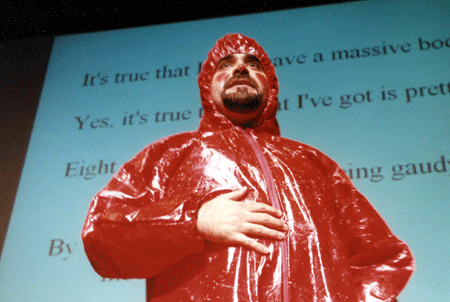
The Nano Mikado
Libretto for the nano-opera: "Atom
and Eve"
By Marc Abrahams
ATOM:
It's elementary.
I know I'm just an atom,
Down in the lowest stratum
Of humblest society.
From what I learned in school
I know I should be bonding.
My parents are desponding
Because I'm not a molecule.
My future seems so, so, so very miniscule.
What if I dream of bigger things?
They will object.
Oh, sorrow!
They say I'm made of tiny strings.
Are they correct?
Oh, sorrow, sorrow!
I feel some larger force
From some enormous source.
I dream of inter--.
Can we connect?
Tomorrow? Tomorrow?
Discuss
By Marc Abrahams
ATOM:
It's elementary.
I know I'm just an atom,
Down in the lowest stratum
Of humblest society.
From what I learned in school
I know I should be bonding.
My parents are desponding
Because I'm not a molecule.
My future seems so, so, so very miniscule.
What if I dream of bigger things?
They will object.
Oh, sorrow!
They say I'm made of tiny strings.
Are they correct?
Oh, sorrow, sorrow!
I feel some larger force
From some enormous source.
I dream of inter--.
Can we connect?
Tomorrow? Tomorrow?
Discuss
Cryonics running hot and cold
Future Timeline: Futurist Re-animated Today:
Meanwhile, back in our "when," Alcor celebrates a victory over the state of Arizona. But how can they stay cool in such a dry heat?
Related Posts
You click, you buy
Ted Williams/Babe Ruth Autographed 20' x 24' Framed Photo - Autographed By Ted WIlliams
Timothy Leary'S Last Trip (DVD)
Ted Williams Autographed Sports Illustrated Issue (11/25/96)
|
|
The (Nano) Apprentice
From USA
TODAY
You click, you buy |
|
Subscribe to:
Posts (Atom)